Making leadership learning inclusive
It’s a loved Kiwi brand; from our trusted Four Squares to the New Worlds and Pak n Save supermarkets throughout the motu. And it all starts with great culture and great leadership. That’s why, when Foodstuffs North Island Supply Chain went looking to develop their future leaders, they wanted to create a solution which was inclusive and fit for purpose.
At the heart of Foodies’ strategy is to create leaders who are worth following, says Supply Chain Learning and Development Lead Kirsty Harrison. “People are the most important thing. If you don’t have your people behind you, then you really don’t have anything.”
The Issue
Foodstuffs take their mission to have a diversity of leaders across the business seriously. But sometimes, attracting talent from all areas to a leadership pathway, is not so obvious.
Kirsty identified that for successful leadership learning to happen, the offering needed to be accessible both in terms of logistics and bringing people together, but also “creating and fostering and environment where people feel comfortable to partake in the learning.”
“Some of our people left school at an early age and are more practical by nature, but that doesn’t mean that they won’t make great leaders” says Kirsty.
So how do we create an environment where people are curious to develop their skills and abilities, where they can turn up, contribute and then share with peers across our network?” That’s where the collaboration with Upskills came in.
Group selection and dynamics was also key, with sharing of experiences and reflecting with peers an important part of the learning process to develop leadership capability.
What we did
Mapping an NZQA leadership qualification to give it a Foodies flavour
For new and emerging team leaders, the NZ Certificate in Business (Team Leadership) was a great fit with what Kirsty and the Foodies’ team were looking for.
Making sure the leadership learning was relevant and applicable meant context and real world Foodies examples were key. Learners had the chance to transform a workplace issue by giving it the problem solving treatment and coming up with a solution they put into action during the course. This continuous improvement project anchored the course and learning as well as bringing real return on investment back to the Supply Chain team. The qualification and learning was supported by ServiceIQ.
Emotional Intelligence framework
The course was mapped to a framework of Daniel Goleman’s emotional intelligence, where the research is clear on the benefits to leadership.
Research shows that leaders with high levels of emotional intelligence can improve their team’s performance and boost employee engagement (Korn Ferry Institute, 2018). As the creator of the term ‘emotional intelligence’ Psychologist and Author Daniel Goleman says: “The rules for work are changing. We’re being judged by a new yardstick: not just by how smart we are, or by our training and expertise, but also by how well we handle ourselves and each other.”
With emotional intelligence content at the heart of the learning, other topics naturally aligned to the course, including:
- leadership styles
- growth mindset
- high performing teams
- inclusive leadership
- diversity equity and inclusion
- GROW coaching
- conflict management
- courageous conversations
- time management
- delegation
- continuous improvement
- wellbeing
Upskills Approach
Having used Upskills as a provider previously with Project Ikuna, Kirsty knew the Upskills culture, facilitators and approach were well aligned to Foodies.
Upskills tutor Shelly Pathak was a great fit for this group as she values the importance of authenticity. “ It was really important to me that everyone could be themselves. Life carries on around us and training doesn’t happen in a vacuum,” says Shelly.
Whanaungatanga
Maintaining relationship and momentum in between sessions was another important aspect of how the group bonded over time. “We had an active WhatsApp group where I posted photos from our workshops of people being themselves, or a snapshot of a fun team challenge to keep our team spirits high until the next workshop,” says Shelly.
Cultural values
And being culturally responsive to the group was top of mind as well. With South Asian and Pasifika learners, Shelly created space and time for them to reflect on how they want to lead their teams in a way that is true to their values of communal leadership. Drawing the links between this and leadership principles brought the content alive in ways that were relevant and highly meaningful. “Empathy, recognition of others and communicating with mana really aligned with this group’s values,” says Shelly, “and we explored how we could do this while upholding the integrity of their leadership responsibilities.”
The Impact
As part of our evaluation process, we ask learners to reflect on what’s shifted for them as a result of taking part in the leadership course:
|
Before the Course |
After |
|
I was kind of winging it when it came to my day to day tasks and interactions with my staff.
|
I feel like my leadership style has really flourished and I’m becoming the leader that not only I want to be, but also one that my team and staff can rely on |
|
I have been too soft when dealing with people, sticking to just one style of leadership,
|
I managed to adjust my leadership style to deal with different workers’ attitudes |
|
I was too scared to talk in front of many people
|
I’m always confident to talk in front of many people and not afraid or nervous anymore |
Here’s some other comments from our evaluation process:
“It has helped implement a growth mindset in every situation especially during conflict and difficult conversations.”
“The active listening skills has helped remind us that we need to be empathetic to our team members and listen to understand rather than listen to respond.”“The course helped me grow more not just as a leader but as a person.”
- A huge 96% of participants said they would recommend this course to a friend or colleague.
- 100% of the group said they feel more confident as a leader since completing the course, and were more confident performance managing their teams and having courageous conversations.
As one manager commented: “The course has meant a completely different mindset for all of them – they can take charge and make things happen. They all have much more of a can-do attitude and are more proactive.”
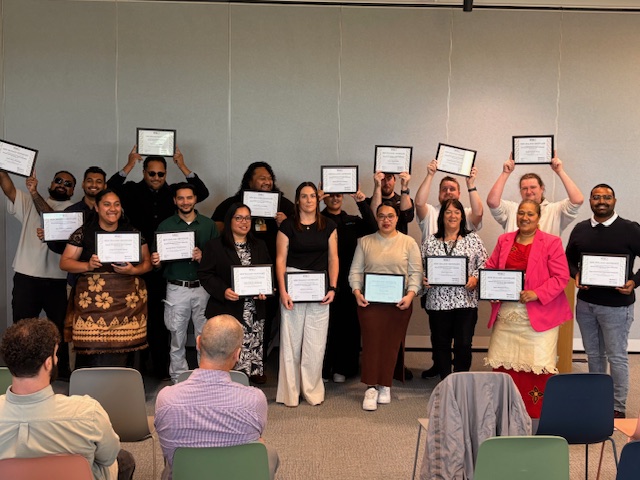
From Kirsty’s perspective, the shift in confidence of this group is noticeable. “Some of them had been very shy to put their hands up, so to see them sharing their learning at the graduation in front of a large group and our senior leaders was incredible.”
The other impact has been around self-awareness as a leader – many of the participants commented that they now ‘respond rather than react’. “Supply Chain is a dynamic environment that is reactive,” says Kirsty. ‘So hearing a reflection like this is gold”
Legacy
When the training workshops are finished, and the assessment mahi completed, Upskills makes sure the learning has had a lasting and continued impact. Putting in metrics are one way of helping us track these ongoing impacts.
- Six participants have been promoted from this cohort already
- People have stepped up into further internal training pathways including the Supply Chain Leadership Foundations course
- The course and its applied project approach has helped cement a culture of continous improvement at Foodies. Project ideas implemented in Supply Chain continue build a stronger supply chain that holds their customers at the core through improved, safety, service and efficiency.
Beyond that, Kirsty is confident the skills gained are being applied and transferred into everyday work. “We always emphasize that leadership isn’t just a title—it’s reflected in how you act, how you live, and everything you do. The real legacy for these participants is to start now by putting their new skills into practice in their current roles and carrying them forward into the future,” she explains. “It’s great to have ambition and think about future roles, but whether it’s communication, feedback, SMART goals, or a growth mindset, these aren’t skills you save for later—they’re tools you can use right now.”